


A morning wellness routine does not need to start at 5 a.m.
You don’t need a 12-step skincare routine, a green smoothie, 30 minutes of meditation, a five-mile run and three pages of journaling before the rest of the world wakes up.
For most people, that’s not a morning routine.
That’s a part-time job.
A useful morning routine should do something much simpler:
help you move from sleeping to starting your day without immediately feeling rushed, scattered or pulled in ten different directions.
And it needs to work on normal mornings.
The mornings when you have work.
The mornings when someone needs you.
The mornings when you didn’t sleep perfectly.
The mornings when you have 10 minutes instead of an hour.
This routine is built around a few simple anchors:
Get up → Hydrate or eat → Get natural light → Get ready → Move a little → Choose your priorities → Enter the digital world intentionally.
You can use all of them or only the ones that genuinely help.
And later in this guide, you’ll build your own 10-, 30- or 60-minute morning routine instead of trying to copy somebody else’s.
First: Stop Trying to Build a Perfect Morning
The fastest way to abandon a morning routine is to make it too complicated.
If your routine requires perfect motivation, perfect sleep and a completely empty schedule, it won’t survive real life.
Instead, ask:
What would make the first part of my morning easier?
Maybe you need less rushing.
Maybe you need five quiet minutes before talking to anyone.
Maybe eating something early works better for you.
Maybe you don’t want breakfast immediately.
Maybe you feel better after moving your body.
Maybe opening your phone before your feet touch the floor is turning your morning into everybody else’s agenda.
Your routine doesn’t have to look impressive.
It has to help you start your actual day.
1. Get Out of Bed Before Starting Your Digital Day
You don’t need to pretend your phone doesn’t exist.
But there’s a difference between intentionally checking something and waking up directly into a stream of messages, headlines, emails, videos and notifications.
Try creating one simple rule:
Get out of bed before you start scrolling.
Your phone can still be nearby.
You can still check the time.
You can still respond to something genuinely urgent.
The goal isn’t a dramatic “digital detox.”
It’s simply to avoid spending the first 15 minutes of your morning reacting to information you didn’t choose.
If you automatically reach for apps, make the habit slightly less convenient:
- move social apps away from your home screen
- turn off nonessential overnight notifications
- charge your phone somewhere you have to physically reach for it
- use Do Not Disturb until a time that makes sense for you
- decide which apps you’re willing to open before breakfast
You don’t need perfect discipline.
A little friction can be enough.
2. Drink Something
You don’t need to force yourself to drink a giant bottle of lemon water at sunrise.
Just give yourself something to drink.
For many people, plain water is the easiest option.
If you prefer tea or coffee as part of your morning, that’s fine too.
An easy trick is to remove the morning decision entirely.
Before bed:
- leave a clean glass near the sink
- fill a reusable bottle
- put your favorite mug near the coffee maker
- prepare whatever makes your normal morning drink easier
Tiny preparation beats relying on sleepy motivation.
3. Get Some Natural Light
Once you’re up, open the curtains or blinds.
If possible, spend a few minutes somewhere with daylight — by a window, on a balcony, on the porch or outside.
You don’t need to turn it into another elaborate ritual.
Open the house.
Step outside while your coffee brews.
Drink your morning beverage near a bright window.
Walk to the mailbox.
Take the dog outside.
If you already leave home early, your normal walk to the car, train or bus may naturally give you some outdoor light.
The goal is simply to stop spending the entire first part of your morning in a dark bedroom.

4. Decide Whether Breakfast Belongs in Your Routine
You don’t need to eat the moment you wake up just because somebody else’s “perfect morning” includes breakfast at 6:15.
And you don’t need to skip breakfast because someone online told you that was superior either.
Build this part around your preferences, schedule and individual needs.
If you like breakfast, make it easy enough to happen on ordinary mornings.
A few practical options:
- Greek yogurt with fruit and nuts
- eggs with toast
- oatmeal with fruit
- cottage cheese with fruit
- toast with nut butter and banana
- overnight oats prepared the night before
- a simple smoothie when you need something portable
If you don’t want food immediately, don’t force an elaborate breakfast ritual into your first 30 minutes.
You can simply decide when eating normally fits your morning and prepare for that.
The useful question isn’t:
“What is the perfect breakfast?”
It’s:
“What can I realistically eat on a Tuesday when I’m busy?”
5. Get Ready Before You Start Wandering Around the House
There is a strange morning trap where you start doing random things before you’re actually ready for the day.
You notice laundry.
Then dishes.
Then something on the counter.
Then you check an email.
Twenty minutes disappear and you’re still in pajamas.
Try giving basic hygiene and getting dressed a clear place in your routine.
Your sequence might be:
Bathroom → Brush teeth → Wash face or shower → Skincare → Hair → Get dressed.
It doesn’t need to be complicated.
If mornings regularly become chaotic because you’re deciding what to wear, remove that decision the night before.
Choose your clothes.
Put together anything you need to take with you.
Make sure the thing you planned to wear isn’t sitting wet inside the washing machine.
Future-you will appreciate the effort.
6. Move for 2–10 Minutes
This is not your workout unless you want it to be.
Morning movement can be tiny.
The purpose is simply to transition from sleeping and sitting into moving your body.
Try:
- walking outside for five minutes
- gentle stretching
- a few mobility movements
- walking around the block
- putting on one song and moving while it plays
- doing a short yoga sequence
- taking the stairs
- walking the dog
- doing a few bodyweight movements you already know
Don’t create a 45-minute exercise requirement if that’s the reason you keep doing nothing.
Start with:
“What movement would I actually do for five minutes?”
Five minutes you repeat is more useful than an ambitious routine you avoid.

7. Choose Your Top Priorities Before the Day Chooses Them for You
You don’t need a complicated productivity system every morning.
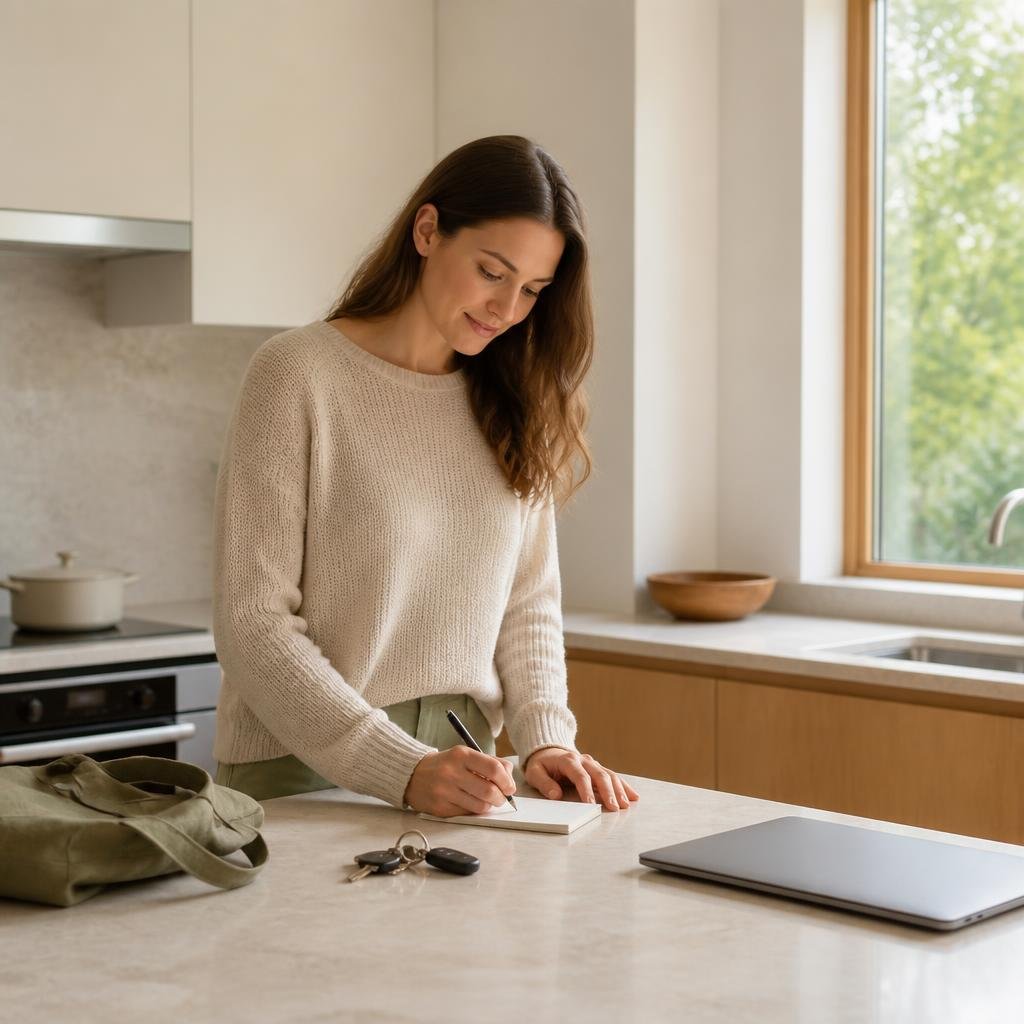
Take a piece of paper, planner or notes app and ask:
What actually needs my attention today?
Choose one to three priorities.
Not 17.
Not every task you’ve been avoiding since March.
One to three things that would make you say:
“Okay, the important stuff moved forward today.”
You can separate them like this:
Must: Something that genuinely needs to happen.
Should: Something important that would be useful to move forward.
Could: Something optional if time and energy allow.
For example:
Must: Send the project by 3 p.m.
Should: Schedule the appointment.
Could: Organize the bathroom cabinet.
Now your brain has somewhere to aim.
8. Do a 60-Second “What Do I Need Today?” Check
Before racing into the rest of the day, ask yourself one practical question:
What would make today easier?
Maybe the answer is:
I need to bring lunch because I won’t have time to buy anything.
I need my umbrella.
I need to leave 15 minutes earlier.
I need to say no to one extra commitment.
I need to bring my water bottle.
I need to take a real break between meetings.
I need to call someone before the office closes.
This isn’t deep journaling.
It’s a one-minute reality check.
Sometimes the most useful wellness habit is noticing what the day actually requires before you’re already in the middle of it.
9. Create a Clear “Morning Routine Ends Here” Point
A routine needs an ending.
Otherwise you can accidentally turn “wellness” into procrastination.
Your ending point might be:
I sit down at my desk.
I leave the house.
I open my work email.
I start the school run.
I begin my first task.
That moment tells your brain:
Morning preparation is finished. Now the day begins.
You don’t need to keep adding habits because there is technically more you could do.
The 10-Minute Morning Wellness Routine
Some mornings are short.
That doesn’t mean the routine has failed.
Here’s a version that fits into roughly 10 minutes:
Minute 0–1: Get Up
Get out of bed before scrolling.
Open the curtains.
Minute 1–2: Drink Something
Have water or start your usual morning drink.
Minute 2–6: Basic Hygiene
Bathroom, teeth, face and whatever you genuinely need before getting dressed.
Minute 6–8: Move
Stretch, walk around the house or do a few mobility movements.
Minute 8–10: Choose Today’s Priorities
Write down your one to three most important things.
Done.
No meditation marathon required.
The 30-Minute Morning Wellness Routine
With 30 minutes, you can create a calmer transition without turning your morning into a project.
Minutes 0–5: Wake + Light + Drink
Get up.
Open the curtains.
Drink water, coffee or tea.
Avoid immediately disappearing into notifications.
Minutes 5–15: Get Ready
Bathroom.
Teeth.
Face or quick shower.
Skincare.
Get dressed.
Minutes 15–20: Move
Stretch, walk or do a short mobility routine.
Minutes 20–25: Breakfast or Food Prep
Eat something simple if you like breakfast, or prepare what you’ll eat later.
Minutes 25–30: Plan
Choose your top priorities.
Ask:
“What would make today easier?”
Then begin your day.
The 60-Minute Morning Wellness Routine
An hour gives you more breathing room.
It does not mean you need twice as many habits.
Use the extra time to move more slowly.
Minutes 0–10: Wake Slowly
Get up.
Open the curtains.
Have your drink.
Spend a few minutes in natural light.
Minutes 10–25: Get Ready
Shower if you want one.
Do your normal hygiene and skincare.
Get dressed.
Minutes 25–40: Breakfast
Prepare and eat something you actually enjoy.
Don’t turn breakfast into a nutrition performance.
Make something that fits your morning.
Minutes 40–50: Movement
Walk, stretch, do yoga or complete another short form of movement you enjoy.
Minutes 50–60: Prepare for the Day
Choose your priorities.
Check what you need to bring.
Look at your calendar.
Then intentionally transition into work, family responsibilities or wherever your day is taking you.
Build Your Own Morning Routine: 10 / 30 / 60 Minutes
Now create a routine around your life, not mine and definitely not an influencer’s.
Choose your available time first:
I Usually Have:
□ 10 minutes
□ 30 minutes
□ 60 minutes
Now choose your anchors.
You do not need every option.
WAKE
□ Get out of bed before scrolling
□ Open curtains
□ Step outside briefly
DRINK / FOOD
□ Water
□ Coffee or tea
□ Breakfast
□ Prepare food for later
GET READY
□ Brush teeth
□ Wash face
□ Shower
□ Skincare
□ Hair
□ Get dressed
MOVE
□ Stretch
□ Walk
□ Mobility
□ Yoga
□ Other short movement
PLAN
□ Check calendar
□ Choose 1–3 priorities
□ Ask “What would make today easier?”
□ Prepare what I need to take with me
DIGITAL
□ Keep notifications off until ______
□ Don’t open social media before ______
□ Check only essential messages
□ Start work intentionally
Now put your chosen steps in an order that makes sense.
Make Your Routine Easier the Night Before
If mornings repeatedly fall apart, the solution may not be adding another morning habit.
It may be removing morning decisions.
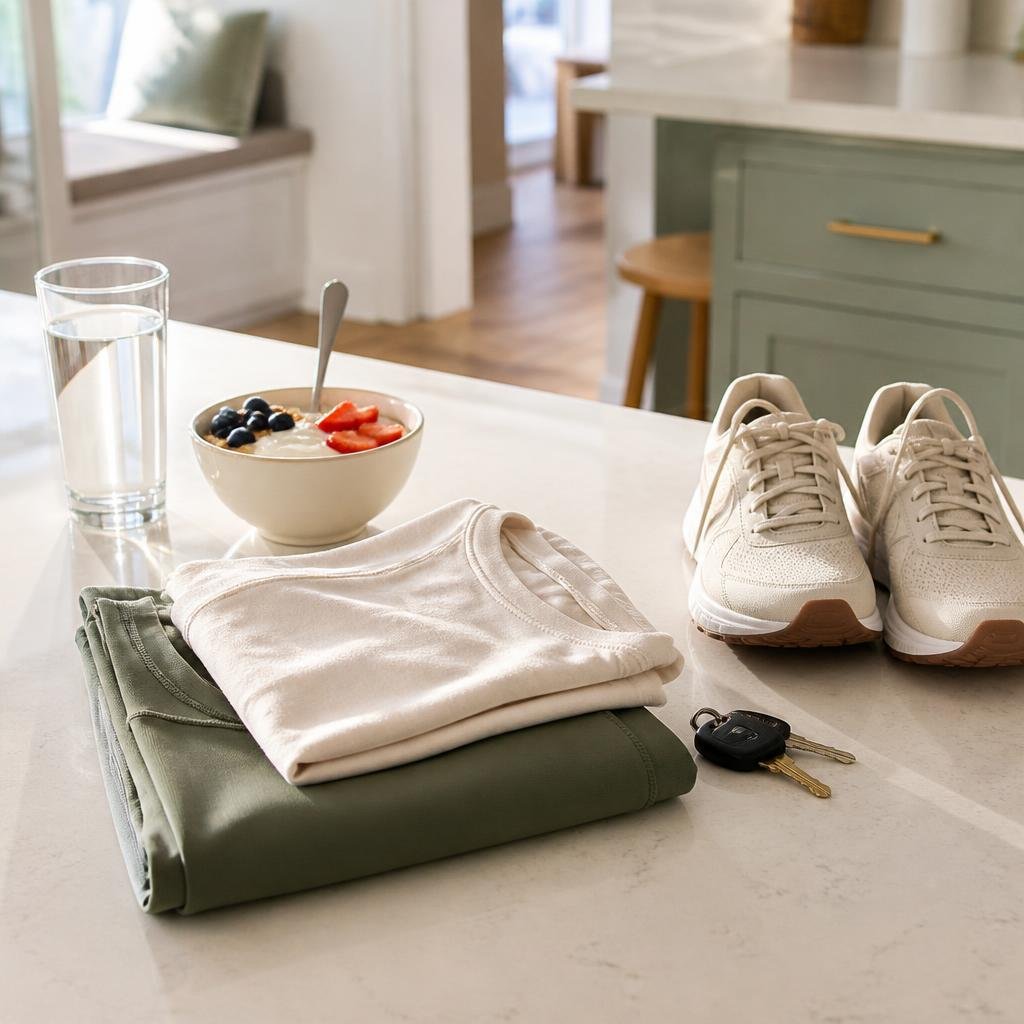
Before bed, consider doing two or three things:
- choose your clothes
- put your keys where they belong
- prepare your bag
- fill your water bottle
- prepare overnight oats
- check tomorrow’s weather
- put breakfast ingredients together
- charge your phone
- check what time you actually need to leave
You don’t need a full evening reset.
Just remove the decisions that regularly create friction in your morning.
What If You Miss Your Routine?
Nothing dramatic happens.
You haven’t “ruined your day.”
Don’t make your routine so psychologically important that missing it creates more stress than the routine was supposed to prevent.
If you wake up late, use the 10-minute version.
If you have five minutes, choose two anchors.
If the morning completely falls apart, continue with your day.
Then start again tomorrow.
A useful routine should be easy to return to.
Your Morning Routine Should Make Your Morning Easier
The goal isn’t to squeeze as much self-improvement as possible into the hour after waking up.
It’s to create a small transition between sleep and everything the day is about to ask from you.
Maybe your ideal morning includes movement.
Maybe it includes breakfast.
Maybe it includes ten quiet minutes with coffee.
Maybe you have children, pets, an early commute or a schedule that makes long routines unrealistic.
That’s okay.
Start with the amount of time you actually have.
Choose a few anchors that genuinely help.
Prepare what you can the night before.
And when life changes, change the routine with it.
The best morning wellness routine isn’t the most impressive one.
It’s the one that makes an ordinary morning feel easier to begin.