
Night skincare routine order is easier than it looks. You do not need a shelf full of products or a complicated 10-step routine before bed. What matters is applying the products you actually need in a logical order.
For most people, the basic nighttime order is:
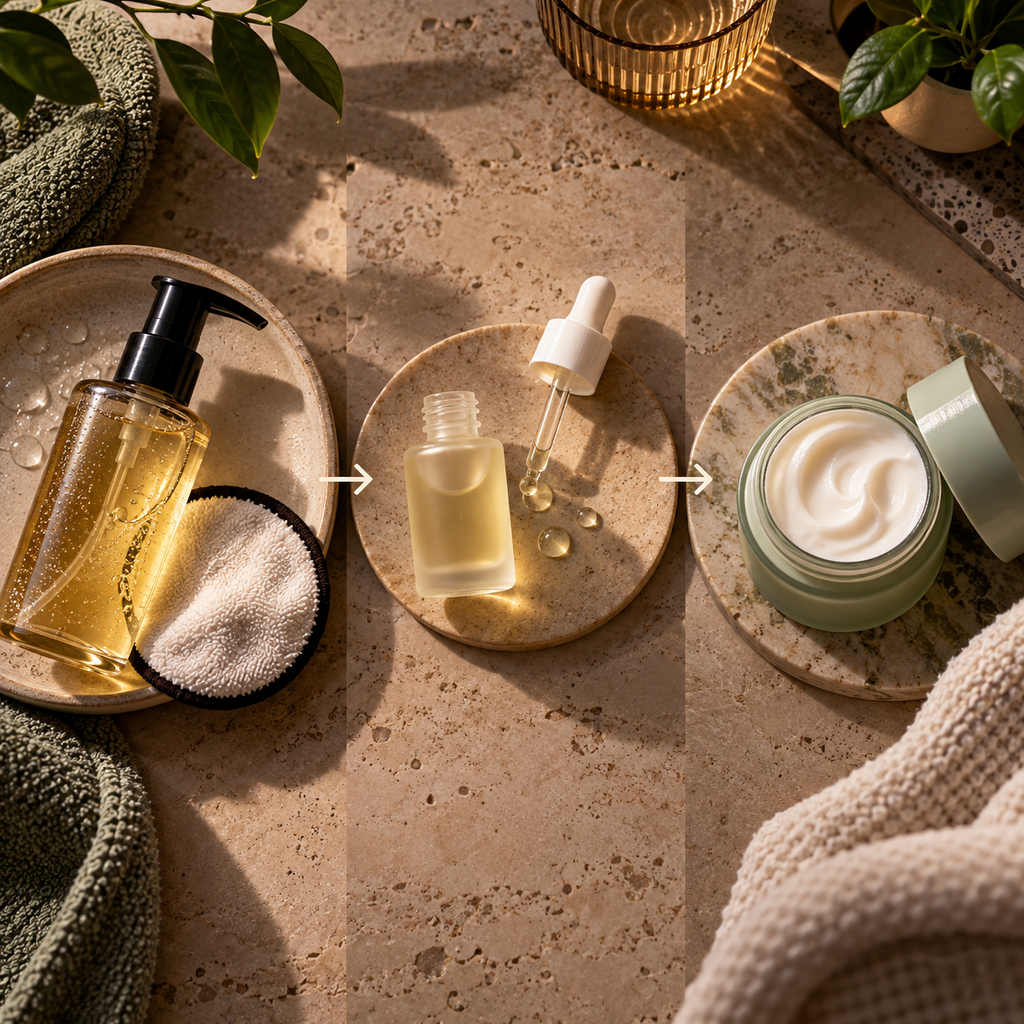
Remove makeup if needed → Cleanse → Treatment if needed → Moisturize
Toner, additional serums, eye cream, and face oil can have a place in a routine, but they are not automatically necessary.
Here is exactly what goes where — and what you can skip.
Night Skincare Routine Order at a Glance
If you just want the correct order before getting into the details, use this as your guide:
- Remove makeup or difficult-to-remove sunscreen — if needed
- Cleanse
- Toner — optional
- Treatment or serum — if needed
- Eye cream — optional
- Moisturize
- Face oil — optional
For a basic routine, you can simplify that to:
Cleanser → Treatment if needed → Moisturizer
If you are still figuring out which products belong in your routine in the first place, start with How to Build a Skincare Routine for Beginners.
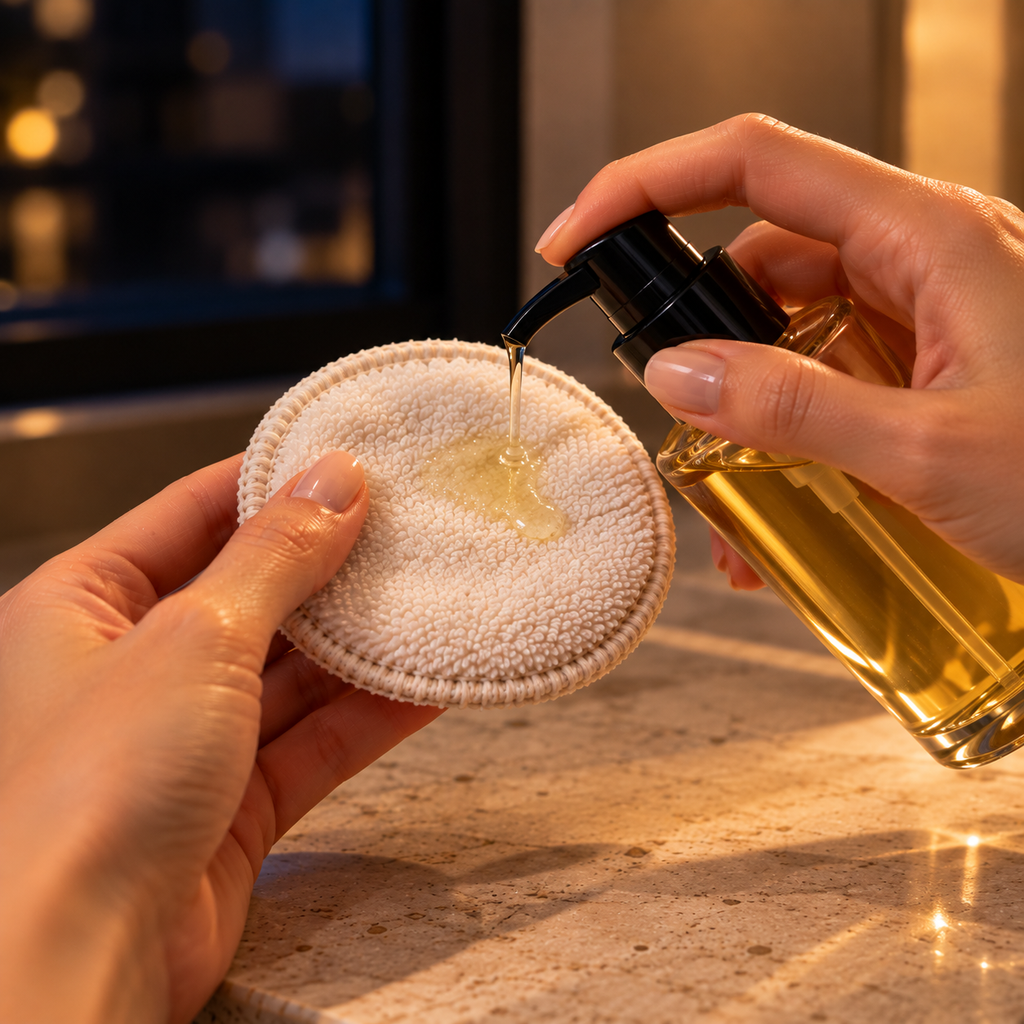
Step 1: Remove Makeup If Needed
If you wear makeup, remove it before using your regular facial cleanser.
Depending on what you wear, you might use micellar water, cleansing balm, cleansing oil, or another makeup remover.
The purpose of this step is simple: remove makeup and other products that may not come off completely with your regular cleanser.
What about sunscreen?
A separate first cleansing step can also be useful when you are wearing water-resistant or difficult-to-remove sunscreen.
But this does not mean everyone needs to double cleanse every single night.
If you are not wearing makeup and your regular cleanser adequately removes what is on your skin, you may be able to go directly to cleansing.
Step 2: Cleanse Your Face
Cleansing is the first essential step in the actual nighttime skincare routine.
Use a gentle facial cleanser with lukewarm water and massage it over your skin with your fingertips rather than aggressively scrubbing.
Then rinse thoroughly and gently pat your skin dry.
Your face should feel clean afterward, not painfully tight or stripped.
If your skin regularly feels uncomfortable after cleansing, take another look at the cleanser you are using and how you are using it.
And remember that facial skincare is only one part of your overall body-care routine. If you want the correct sequence for hair, shower, exfoliation, shaving, and body moisturizer too, see Everything Shower Routine: The Right Order From Head to Toe.
Step 3: Toner — Optional
If toner is already part of your routine, it generally goes:
Cleanser → Toner → Treatment
But toner is not a required step simply because you see it in elaborate skincare routines online.
If you use one that works well for your skin, keep it.
If you do not use toner, you do not need to add one just to fill the space between cleansing and your next product.
After toner — or directly after cleansing if you skip it — move on to any treatment or serum you actually need.
Step 4: Apply Your Treatment or Serum
Treatments and serums generally come before moisturizer.
This is the part of your routine designed for a particular purpose rather than basic cleansing or moisturizing.
Depending on your individual routine, this could include an acne treatment, retinoid, or another targeted product.
That does not mean you need several treatments every night.
If you use a prescription treatment, follow the directions provided by your dermatologist or prescriber rather than changing its application based on a generic skincare layering guide.
Where does retinol go?
Retinol belongs in the treatment portion of a nighttime routine.
A simple sequence may look like:
Cleanser → Retinol → Moisturizer
Retinoids can be irritating for some people, particularly when first introduced, so follow the instructions for the specific product you use.

Be Careful When Combining Active Products
Owning several active skincare products does not mean they all belong in the same nighttime routine.
If you use retinoids, exfoliating acids, acne treatments, or other potentially irritating products, check the directions for each one before layering them together.
Introducing several new active products at the same time can also make it difficult to figure out what is causing a problem if your skin becomes irritated.
A simpler approach is easier to manage:
Know why you are using each treatment and introduce new products carefully.
If a product label gives specific instructions about application, frequency, or combinations to avoid, follow those directions.
And if you use prescription skincare, follow the plan provided by your healthcare professional.
Step 5: Eye Cream — Optional
If you use eye cream, it generally goes after your serum or treatment and before your facial moisturizer.
But it is an optional addition rather than a requirement for a complete nighttime routine.
If you already have one you enjoy using and it works for you, this is where it fits.
Otherwise, there is no reason to add an eye cream simply to make your routine feel complete.
Step 6: Moisturize
For a basic routine, moisturizer is the final essential step.
After cleansing and applying any treatment you use, apply your moisturizer.
You do not automatically need an extremely heavy cream simply because it is nighttime. Choose a moisturizer that suits your skin and that you are comfortable using consistently.
If you use no additional products, your entire routine can end here:
Cleanse → Moisturize
If you use a treatment:
Cleanse → Treatment → Moisturize
That is a complete nighttime routine.

Step 7: Face Oil — Optional
If you use a face oil, it generally belongs near the end of the routine, after lighter skincare products.
For example:
Cleanser → Treatment → Moisturizer → Face Oil
But face oil is another optional step.
If your skin is comfortable with your existing cleanser, treatment, and moisturizer, there is no rule saying you need to add an oil before bed.
Do You Need to Wait Between Skincare Steps?
Usually, you do not need to wait a fixed number of minutes between every product.
Give each product enough time to spread and settle comfortably before applying the next one.
However, some treatments have specific instructions about when and how they should be applied. A product may need to be used on dry skin, for example, or its directions may tell you to use it differently.
In those cases, follow the instructions for that specific product rather than applying a universal waiting rule to your entire routine.
Night Skincare Routine vs. Morning Skincare Routine
Your morning and nighttime routines may use some of the same products, but the order is not identical.
A basic night routine focuses on:
Cleanse → Treat if needed → Moisturize
The morning adds an essential step that does not belong at the end of your nighttime routine: sun protection.
A simple way to remember the difference is:
Morning: cleanse or refresh → moisturize → protect
Night: cleanse → treat if needed → moisturize
For the complete daytime sequence, see Morning Skincare Routine: The Correct Order to Apply Your Products.
What If You Are Too Tired for Your Full Night Routine?
Simplify it.
You do not have to choose between completing every possible skincare step and doing nothing at all.
On a tired night, focus on the essentials:
- Remove makeup if needed.
- Cleanse.
- Use a treatment if it is part of your necessary routine.
- Moisturize.
Skip the optional extras.
This is one reason a realistic routine often works better than an elaborate one: there is less to abandon when you are tired.
How Many Products Do You Actually Need at Night?
There is no universal number.
Someone using only basic skincare may have:
Cleanser + moisturizer
Someone using a targeted treatment may have:
Cleanser + treatment + moisturizer
Additional products should have a clear reason for being there.
Before adding another step, ask:
What is this product supposed to do in my routine?
If you cannot answer that question, do not assume your routine is incomplete without it.
Simple Night Skincare Routine for Beginners
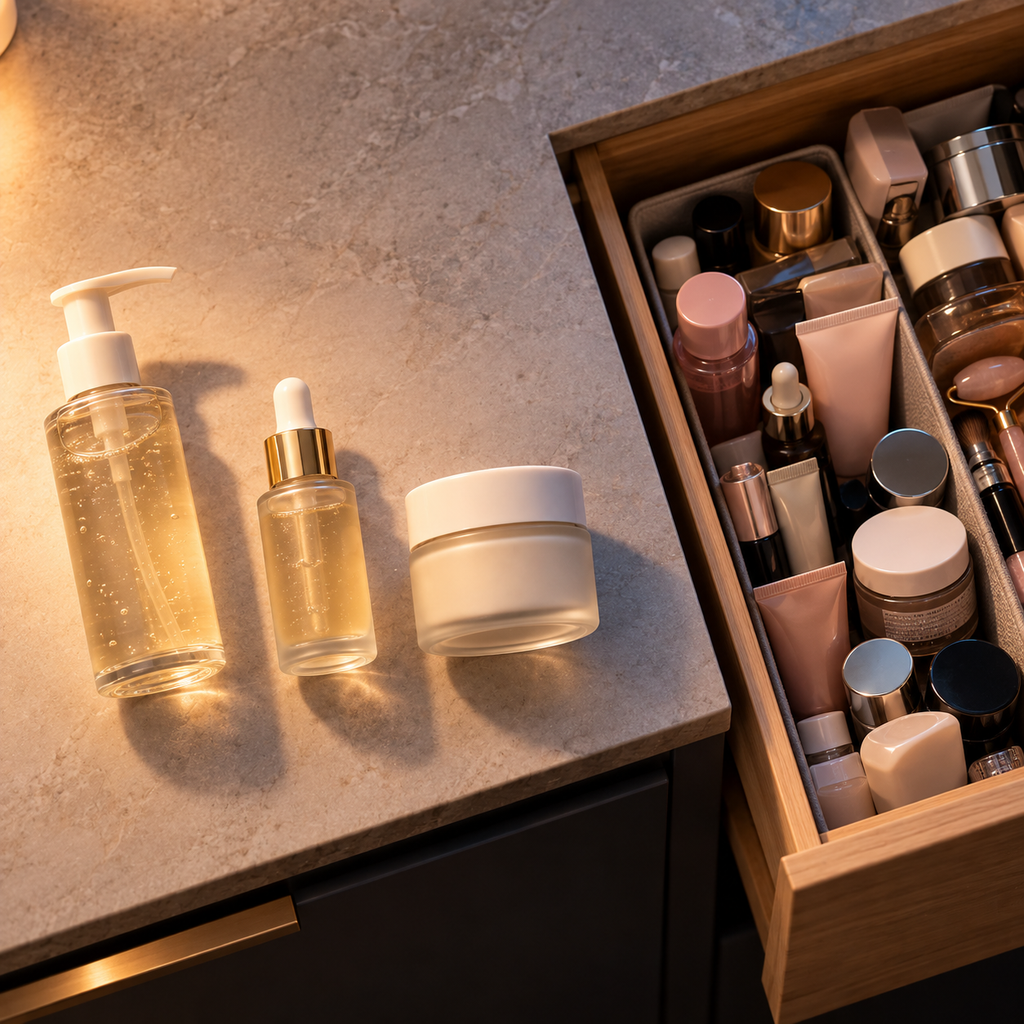
If you are starting from scratch, keep your first routine simple.
1. Cleanse
Gently remove makeup, sunscreen, excess oil, and the day’s buildup.
2. Use a treatment only if you need one
If you have a specific treatment in your routine, use it according to its directions.
3. Moisturize
Finish with a moisturizer appropriate for your skin.
Use your basic routine consistently before deciding whether another product actually needs to be added.
Starting five new products at once may look impressive on the bathroom counter, but it makes it much harder to tell which products are actually helping — or which one your skin does not like.
Night Skincare Routine Order FAQ
What is the correct order for a nighttime skincare routine?
For a simple routine, use:
Cleanser → Treatment if needed → Moisturizer
If you wear makeup or difficult-to-remove sunscreen, remove that before cleansing. Toner, eye cream, and face oil are optional additional steps.
Does serum go before or after moisturizer?
Serum generally goes before moisturizer.
A typical order is:
Cleanser → Serum → Moisturizer
Does retinol go before or after moisturizer?
Retinol typically belongs in the treatment step before moisturizer, but application instructions can vary by product and individual routine.
Follow the directions provided with your retinoid or by your dermatologist.
Does toner go before serum?
Yes. If you use toner, it generally goes after cleansing and before serum:
Cleanser → Toner → Serum → Moisturizer
Do I need toner at night?
No. Toner is an optional skincare step.
Do I need eye cream at night?
Not necessarily. Eye cream can be included if you want to use one, but it is not required for everyone.
Should I double cleanse every night?
Not automatically.
A first cleansing step can be useful for removing makeup, water-resistant sunscreen, or products that your regular cleanser does not remove adequately.
If one gentle cleanse is enough for you, a second cleanser is not automatically necessary.
Should I do my skincare immediately before going to sleep?
No.
You can do your nighttime skincare earlier in the evening if that makes it easier to stay consistent.
There is no prize for waiting until you are half asleep before remembering you still have to wash your face.
The Bottom Line
The correct night skincare routine order does not have to be complicated.
Start with:
Remove makeup if needed → Cleanse → Treatment if needed → Moisturize
Then add toner, eye cream, face oil, or other products only when they have a clear purpose in your routine.
The goal is not to fit as many products as possible between cleansing your face and going to bed.
It is to build a nighttime routine that makes sense for your skin and is simple enough to actually follow.