
Building a skincare routine for beginners can feel much more complicated than it actually needs to be.
Cleanser. Toner. Serum. Essence. Eye cream. Retinol. Exfoliating acids. Face oils. Overnight masks.
With so many products and routines online, it’s easy to assume you need a bathroom shelf full of skincare before you’ve even started.
You don’t.
A simple beginner skincare routine can start with just three essentials: cleanser, moisturizer, and sunscreen. Once those basics become consistent, you can decide whether your skin actually needs anything else.
This guide walks you through exactly what you need, what order to apply your skincare products, how to choose beginner-friendly formulas, common mistakes to avoid, and when it makes sense to add something new.
The Basic Skincare Routine for Beginners
Before buying serums, toners, masks, or trendy treatments, build a routine around the basics.
For most beginners, a simple routine looks like this:
Morning
- Cleanser — or rinse with water if that works better for your skin
- Moisturizer
- Broad-spectrum sunscreen SPF 30 or higher
Night
- Cleanser
- Moisturizer
That’s your foundation.
You don’t automatically need toner, essence, multiple serums, facial oils, masks, exfoliating acids, or separate creams for every part of your face.
Start with products you’ll actually use consistently. Extras can come later — if you have a reason to add them.
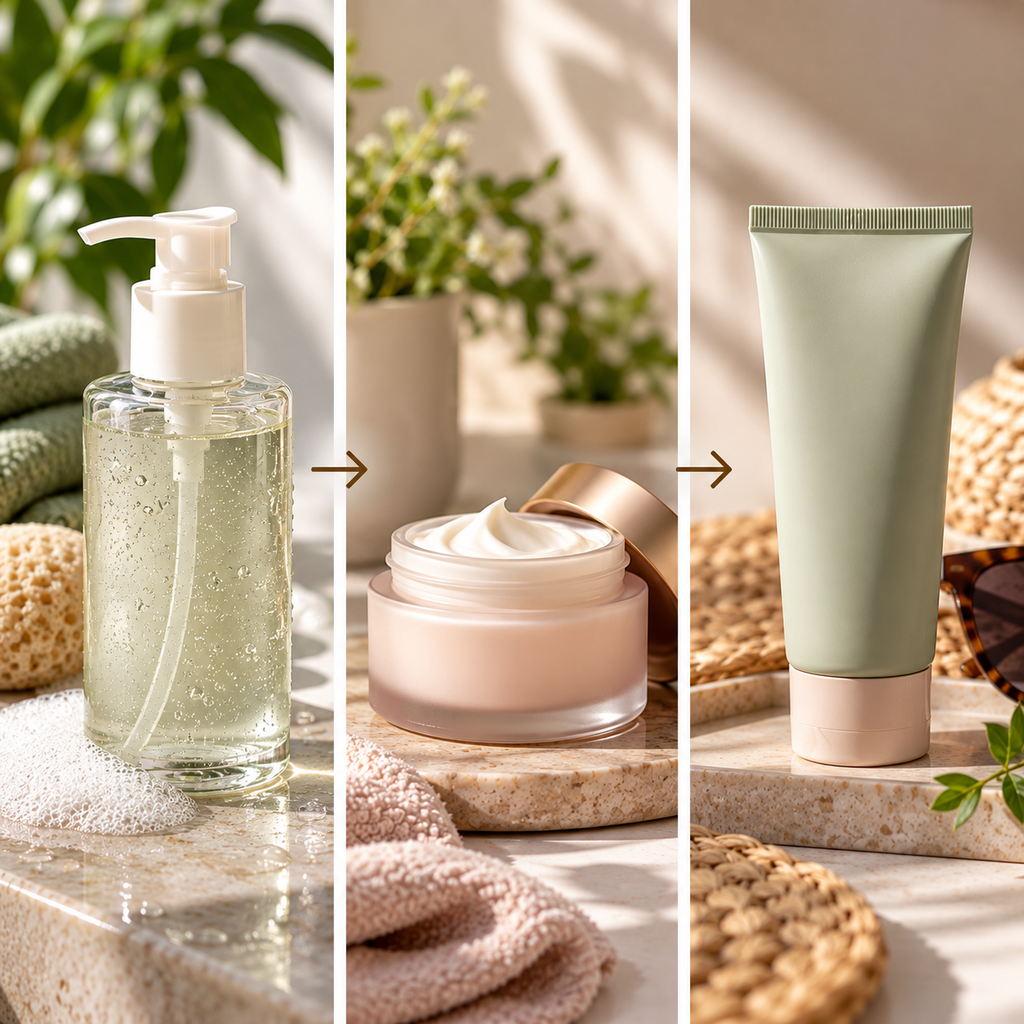
Step 1: Cleanse Your Skin
Cleansing removes sunscreen, makeup, excess oil, sweat, dirt, and everyday buildup from the surface of your skin.
For beginners, the goal isn’t to find the cleanser that makes your face feel the cleanest. It’s to find one that cleans comfortably without leaving your skin feeling stripped.
What should you look for in a cleanser?
Start with a gentle facial cleanser intended for daily use.
After cleansing, your skin shouldn’t feel painfully tight, extremely dry, itchy, or uncomfortable.
That squeaky-clean feeling isn’t something you need to chase.
How to wash your face
Wet your face with lukewarm water.
Apply your cleanser with clean fingertips and gently massage it over your skin. You don’t need aggressive scrubbing or a rough cleansing tool.
Rinse thoroughly and gently pat your face dry.
If you wear makeup or a water-resistant sunscreen that your regular cleanser doesn’t remove easily, you may prefer to remove it first before cleansing at night.
If you’re also trying to organize the rest of your hair and body-care steps, follow our Everything Shower Routine: The Right Order From Head to Toe for a simple head-to-toe shower order.
Step 2: Apply Moisturizer
Moisturizer isn’t only for people with dry skin.
Its basic job is to help keep water in the skin and support the skin barrier. What changes from person to person is the texture that feels best.
If your skin tends to feel oily or you dislike heavy products, you may prefer a lightweight lotion or gel-cream.
If your skin frequently feels dry or tight, a richer cream may feel more comfortable.
Those are starting points, not rigid rules. How a product feels and how your skin responds matter more than the label on the front of the jar.
When should you apply moisturizer?
Apply moisturizer after cleansing.
Many moisturizers can be applied while your skin is still slightly damp.
Start with a small amount, spread it evenly across your face, and add more if needed.
Step 3: Finish Your Morning Routine With Sunscreen
Sunscreen is the step that separates your basic morning routine from your basic nighttime routine.
Choose a broad-spectrum sunscreen with SPF 30 or higher.
Sunscreen goes at the end of your morning skincare routine, before makeup.
Follow the application instructions on your specific sunscreen and make sure you’re covering exposed skin evenly.
Areas people often forget
When they’re exposed, remember your:
- ears
- neck
- upper chest
- hairline
- backs of the hands
If you’re spending time outdoors, follow the product directions for reapplication, particularly after swimming or sweating.
And here’s a very practical rule:
Choose a sunscreen you’re willing to wear.
A formula may look perfect on paper, but if you hate how it feels so much that you keep skipping it, it isn’t a very useful sunscreen for your routine.
Your Simple Morning Skincare Routine
Once you understand the essentials, the order becomes easy.
Beginner morning skincare order
1. Cleanse or rinse
Cleanse your face as needed. Some people prefer a facial cleanser in the morning, while others find that rinsing with water works well for them.
2. Moisturize
Apply a moisturizer that feels comfortable on your skin.
3. Sunscreen
Finish with broad-spectrum SPF 30 or higher.

That’s enough to start.
You can build on this later, but there’s no reason to create a seven-step morning routine before you’ve established these basics.
Your Simple Night Skincare Routine
Your beginner nighttime routine can be even simpler.
Beginner nighttime skincare order
1. Remove makeup if needed
If you wear makeup, remove it before or as part of cleansing, depending on the products you use.
2. Cleanse
Wash away sunscreen, makeup residue, oil, sweat, and everyday buildup.
3. Moisturize
Finish with your moisturizer.

You don’t automatically need a separate night cream, sleeping mask, face oil, eye cream, and multiple serums.
Start simple.
You can always add targeted products later.
Morning vs. Night Skincare: What’s the Difference?
The main difference is what your routine needs to accomplish.
Your morning routine prepares your skin for the day and includes sun protection.
Your night routine removes the day’s buildup and leaves your skin cleansed and moisturized.
An easy way to remember it is:
Morning: cleanse → moisturize → protect
Night: cleanse → moisturize
That’s a perfectly legitimate skincare routine.
What Order Should You Apply Skincare Products?
For a basic beginner routine, the order is straightforward.
Morning
Cleanser → Moisturizer → Sunscreen
Night
Cleanser → Moisturizer
If you later introduce a treatment or serum, its position depends on the product and its instructions.
A common routine may look something like:
Cleanser → Treatment or serum → Moisturizer → Sunscreen in the morning
But don’t assume every skincare product follows the same rule.
Some treatments have specific application instructions or shouldn’t be combined with certain other products. When you eventually add one, check the label and directions for that particular product instead of trying to memorize one universal skincare formula.
How Much Skincare Product Should You Use?
More isn’t automatically better.
Using far more product than necessary can waste your skincare and doesn’t guarantee better results.
Cleanser
Use enough to comfortably spread across and cleanse your face.
The exact amount varies depending on whether you’re using a gel, cream, foam, balm, or another formulation, so check the directions on your product.
Moisturizer
Start with a small amount that you can comfortably spread across your face.
If it isn’t enough, add a little more.
Sunscreen
Don’t deliberately use less sunscreen to make a bottle last longer.
Use the amount directed on the product label and cover exposed areas evenly. Sunscreen needs to be applied adequately to provide the labeled protection.
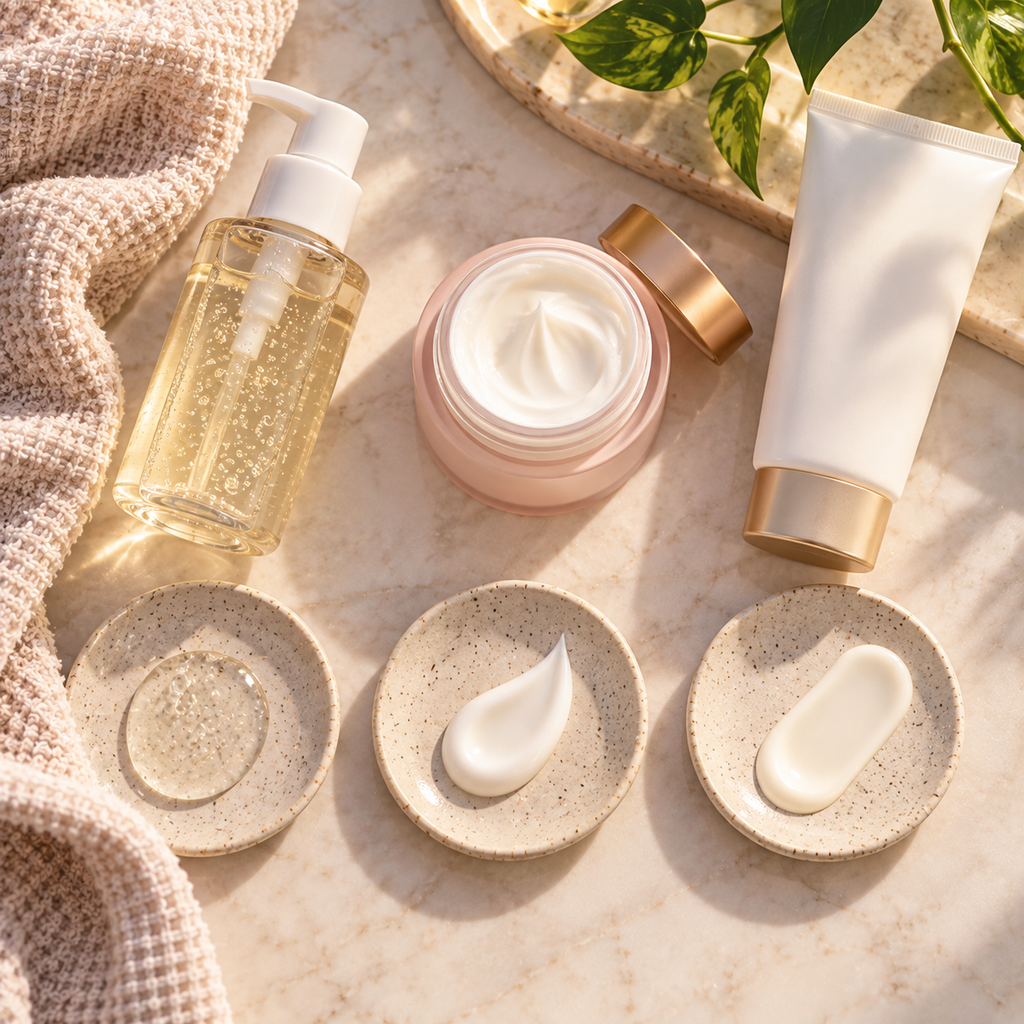
The internet loves precise blobs and perfectly measured skincare displays, but products have different formulations, packaging, and instructions.
The directions on your actual product matter more than copying a photograph.
How to Choose Skincare Products as a Beginner
This is where skincare shopping can get expensive very quickly.
Instead of buying whatever happens to be trending, evaluate each product based on what you actually need.
If your skin often feels oily
You may prefer lightweight cleansers, lotions, gel-creams, and sunscreens that don’t feel excessively heavy.
If your skin often feels dry or tight
A gentle cleanser and a more moisturizing cream may feel more comfortable.
If some areas feel oily and others feel dry
You don’t necessarily need two completely different routines.
Start with gentle basics and observe how different areas of your face respond.
If your skin seems easily irritated
Keep the routine especially simple and avoid introducing several new products simultaneously.
These are only general starting points.
Later, we’ll go deeper into routines for individual skin types. For now, your job is simply to establish the basics and learn what your skin tolerates comfortably.
Do Beginners Need Toner?
No. Toner is optional.
It isn’t one of the three essentials of a basic beginner skincare routine.
Modern toners can have very different purposes depending on their formulation. Some are hydrating, some contain exfoliating ingredients, and others are designed for different cosmetic goals.
That means “toner” isn’t one universal step everyone needs.
If you have a simple routine that works without one, there’s no rule saying you need to add it.
Do Beginners Need a Serum?
Not necessarily.
Serums are usually added to address a particular skincare goal, and they’re also where beginners can accidentally make a simple routine unnecessarily complicated.
Instead of buying several serums at once, ask one question:
What am I expecting this product to do?
If you don’t have a clear answer, you probably don’t need to add it yet.
Establish your cleanser, moisturizer, and sunscreen first.
Then, if you decide you have a specific concern you want to address, you can research an appropriate product and introduce it carefully.
Should Beginners Exfoliate?
Exfoliation isn’t mandatory just because you’ve started a skincare routine.
Different exfoliating products work in different ways, and combining too many exfoliating steps can irritate the skin.
A scrub, exfoliating toner, acid serum, peel, and exfoliating mask might each look like separate products on a shelf — but that doesn’t mean they belong in the same routine.
If you decide to introduce exfoliation, start conservatively, follow the product instructions, and avoid adding several exfoliating products at the same time.
Introduce New Skincare Products One at a Time
This is one of the simplest ways to make your routine easier to understand.
Imagine replacing your cleanser, moisturizer, sunscreen, toner, and serum on Monday.
By Thursday, your skin is unhappy.
Which product caused it?
You have no idea.
Instead:
- Establish your basic routine.
- Introduce one new product at a time.
- Pay attention to how your skin responds.
- Follow the product’s directions.
- Only consider another addition once you know how the current routine is working for you.
If you’re concerned about potential irritation or sensitivity, follow any patch-testing guidance provided with the product or by a qualified professional.
8 Beginner Skincare Mistakes to Avoid
Sometimes improving your routine means doing less, not adding another bottle.
1. Starting with too many products
You don’t need an entire skincare collection on your first day.
Start with the essentials.
2. Changing everything at once
Introducing multiple products simultaneously makes it difficult to identify which one is helping — or causing a problem.
3. Scrubbing too aggressively
Your cleanser doesn’t need help from aggressive scrubbing.
Be gentle.
4. Washing with very hot water
Hot water may leave your skin feeling dry or uncomfortable.
Use lukewarm water instead.
5. Skipping moisturizer because your skin feels oily
Try adjusting the texture rather than automatically eliminating moisturizer.
A lightweight product may feel much better.
6. Treating sunscreen like a beach-only product
Sun protection belongs in your regular daytime routine, not just in your vacation bag.
7. Copying someone else’s entire skincare routine
Someone else’s routine was built for their skin, preferences, budget, and concerns.
Use it for inspiration if you want — not as a shopping list.
8. Constantly switching products
Giving up on your entire routine every time another product goes viral makes it very difficult to understand what’s actually working for you.
Keep Your Beginner Skincare Setup Simple
You don’t need a bathroom counter covered in products to take good care of your skin.
A useful beginner setup might contain only:
- one gentle cleanser
- one moisturizer
- one broad-spectrum SPF 30+ sunscreen
- makeup remover, if you need one
That’s enough to establish the habit.
Once the basics become automatic, you can make deliberate additions instead of collecting products first and figuring out what they’re for later.
How Skincare Fits Into Your Full Personal-Care Routine
Facial skincare is only one part of feeling clean and put together.
Hair care, shower habits, body moisturizer, oral care, deodorant, clean clothes, and fragrance habits all contribute to your overall routine.
If you’re building everything from scratch, our Everything Shower Routine: The Right Order From Head to Toe shows you how to organize your shower, hair, and body-care steps.
And if your goal is staying fresh throughout the day, continue with How to Smell Good All Day: A Head-to-Toe Routine for practical ways to combine hygiene, body care, clothing, and fragrance.
You don’t need one enormous routine.
You need a few simple routines that work together.
Beginner Skincare Routine Checklist
Save this as your starting point.
Morning
☐ Cleanse or rinse as needed
☐ Apply moisturizer
☐ Apply broad-spectrum SPF 30+
Night
☐ Remove makeup if needed
☐ Cleanse
☐ Apply moisturizer
Before adding another product
☐ Know what you want the product to do
☐ Introduce one new product at a time
☐ Read the product instructions
☐ Pay attention to how your skin responds
☐ Don’t keep using something that causes significant irritation
Simple enough to remember. Simple enough to repeat.
Frequently Asked Questions About Skincare for Beginners
How many skincare products does a beginner need?
You can build a basic skincare routine with three core products: a cleanser, moisturizer, and broad-spectrum sunscreen SPF 30 or higher.
At night, your basic routine may only require cleanser and moisturizer.
You can add other products later if you have a specific reason to use them.
Should beginners use toner?
Toner is optional.
You don’t need to add one simply because you’ve seen toner included in other skincare routines.
Start with your essentials first.
Do I need a serum in my skincare routine?
Not necessarily.
Serums are usually chosen for specific skincare goals. A beginner can establish a perfectly functional routine without one.
Can I use the same moisturizer morning and night?
Often, yes.
If you have a moisturizer you enjoy using and it works comfortably in both routines, you don’t automatically need separate day and night moisturizers.
Your daytime routine still needs sunscreen as its final skincare step.
How long should I try a skincare routine before changing it?
There’s no single timeline that applies to every product or skincare concern.
Instead of constantly replacing your entire routine, establish your basics and give yourself time to observe how your skin responds.
If a product causes significant burning, swelling, rash, or persistent irritation, stop using it and seek appropriate professional advice rather than waiting for your skin to “get used to it.”
Final Thoughts: Start With a Simple Skincare Routine
The best skincare routine for beginners isn’t the one with the most steps.
It’s the one you understand well enough to follow consistently.
Start with:
Cleanse. Moisturize. Protect.
Learn how your skin responds to those basics before adding extras.
A simple three-step routine you actually follow is far more useful than an elaborate routine that becomes too complicated to maintain.
Once you have your foundation, you can start making smarter decisions about what — if anything — your skin needs next.
And if you’re dealing with persistent acne, painful breakouts, rashes, significant irritation, or another ongoing skin problem, consider seeing a dermatologist or another qualified healthcare professional rather than repeatedly adding new cosmetic products.